Change Management Training Philippines: Mastering Change and Navigate Transitions with Confidence
You’re probably here because you’ve been experiencing both internal and external changes in your organization. You know how important it is for businesses and leaders in your company to respond, as it will be the basis of your long-term success.
Effective change management involves increasing the ability to make smooth, strategic, and beneficial transitions for all stakeholders. Whether it is dealing with market shifts, internal restructuring, changing job roles, or process innovations, our Change Management Training program in the Philippines covers precisely that.
We help professionals navigate transformation effectively by training them with practical strategies, frameworks, and leadership acumen. By mastering change, you can reduce resistance among your teams and develop more adaptability, ultimately driving sustainable success.
Program at a Glance
Everything an L&D or HR lead needs to scope the program before requesting a proposal.
Duration
Half-day (4 hours), 1 day (8 hours), or 2 days (16 hours). We scope duration to your objectives, not the other way around.
Delivery Modes
In-house onsite at your office or venue, live online via Zoom or Teams, hybrid, or blended with follow-through coaching.
Group Size
Ideal group size is 15 to 30 participants per batch. Larger workforces are handled through multiple batches or a train-the-champion rollout.
Locations
Metro Manila, Cebu, Davao, Clark, Baguio, Iloilo, and nationwide via live online delivery. Regional ASEAN engagements on request.
Philippines' Top Change Management Training Provider: Our Impact, Told By Those Who've Experienced It


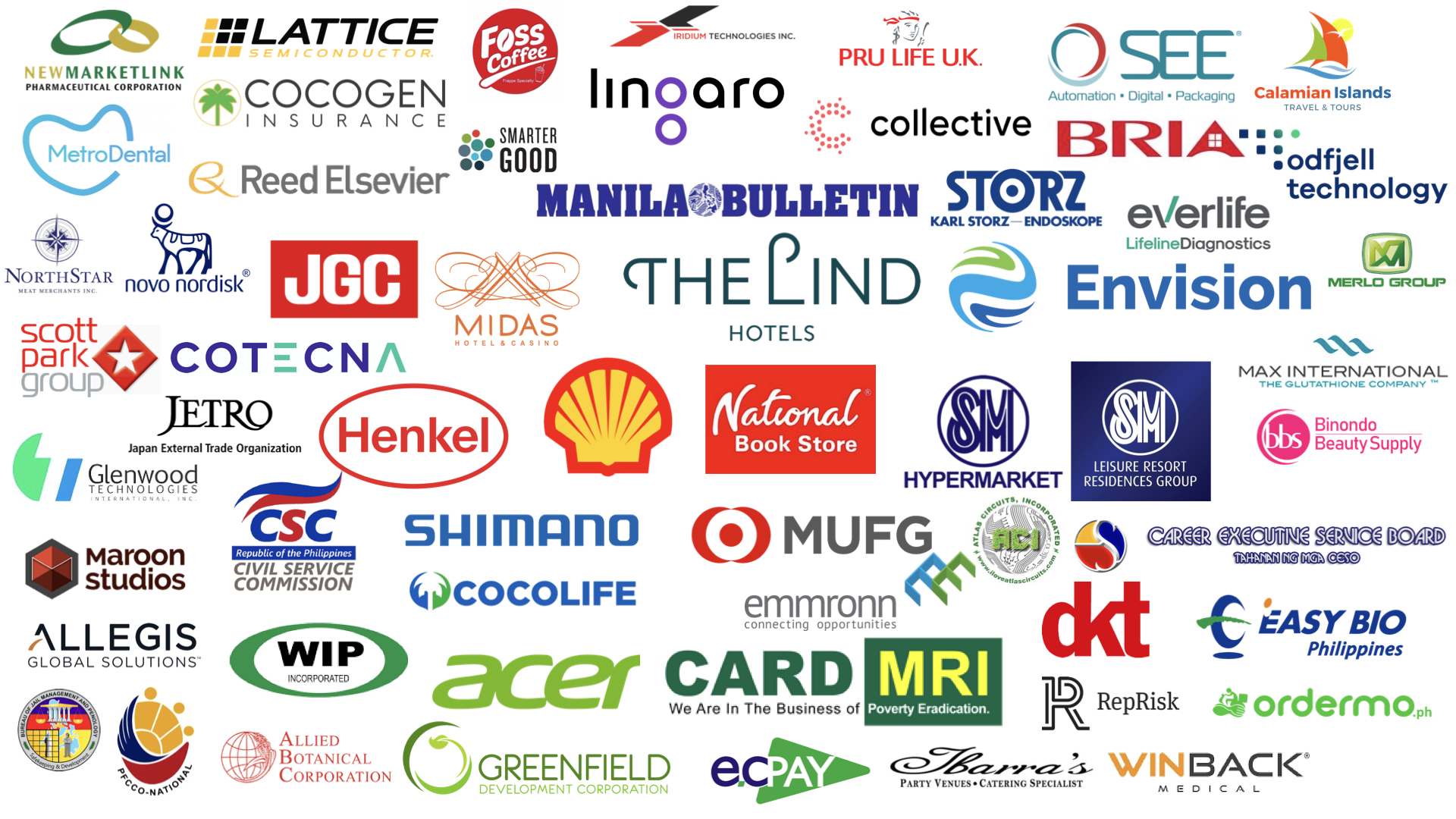
Leaders From Brands Trained By Rainmakers, The Top Change Management Training Provider in the Philippines
Rainmakers' Change Management Training Programs
LeaderShift is our core change management program. The three programs that follow are companion tracks we often pair with it during large transitions.
LeaderShift: Change Management Strategies For Leaders
LeaderShift is a dynamic program designed to equip leaders with the necessary tools to manage and navigate through periods of organizational change effectively. This program emphasizes the development of resilience and adaptability, critical traits for leaders who must steer their teams through transitions and crises. Through practical sessions, participants will learn to lead with agility, ensuring they can promote a culture that embraces change and fosters organizational transformation.
Best for: executives, department heads, and people managers leading a restructuring, system migration, merger, or return-to-office transition.
Executive Advantage: Strategy and Execution for Business Breakthrough
The Executive Advantage program is tailored to enhance the leadership qualities of executives, focusing on building a solid executive presence. Participants will undergo immersive sessions to refine their identity, bolster communication skills, and enhance their ability to drive productivity within their organizations. The program catalyzes leaders seeking business breakthroughs through effective strategy formulation and execution. Invest in our executive leadership training.
Best for: sponsors and C-suite leaders who need to set the change vision before it cascades.
Modern-Day Leadership: Leading in the New Reality
The Modern-Day Leadership program trains leaders to thrive in the contemporary, fast-evolving business environment. This program is structured around five pivotal leadership pillars: Modeling, Connecting, Visioneering, Empowering, and Cultivating. It seeks to prepare leaders with the necessary skills and mindset to navigate the complexities of today’s business world, enabling them to lead with vision, inspire their teams, and foster a culture of empowerment and innovation. See our leadership training.
Best for: newly promoted and mid-level leaders managing hybrid or multigenerational teams through change.
High Performing Teams Training
This training is a comprehensive journey designed to transform groups of individuals into cohesive, high-performing teams. It aims to synchronize individual talents with collective goals, creating a conducive environment for shared success. The program focuses on understanding each team member’s role and strengths, enhancing communication, and fostering a culture of mutual support. Participants will learn strategies to leverage their collective capabilities, ensuring the team can navigate challenges with unity and achieve outstanding results. Learn more about our high performing teams training.
Best for: intact teams that need to rebuild trust and rhythm after a reorganization.
LeaderShift Course Outline
The full 2-day LeaderShift outline. Half-day and 1-day versions compress or drop modules based on your training needs analysis.
- What change management is and why transitions fail without it
- Internal and external drivers of change: market shifts, restructuring, leadership turnover, new systems, regulation
- Types of change: planned, unplanned, transformational, remedial, and organization-wide
- Identifying sources of dissatisfaction that signal the need to change
- Diagnosing organizational readiness with the McKinsey 7-S Model
- Balancing demand versus capability before you commit resources
Activity: readiness diagnostic on a live change initiative from your organization.
- Lewin’s three-stage model: unfreeze, change, refreeze
- Force Field Analysis: mapping driving and restraining forces
- Kotter’s 8-Step Model for large-scale organizational change
- The ADKAR model for individual and team-level adoption
- Bridges’ Transition Model: endings, the neutral zone, new beginnings
- Choosing the right model for the change in front of you
Activity: model selection exercise mapped to three real transition scenarios.
- Writing clear change objectives tied to short-term goals and long-term vision
- Stakeholder mapping by power and interest
- Change impact assessment: who is affected, how much, and when
- Defining change roles: sponsor, change manager, change champion, affected employee
- Visualizing progress and accountability with the Kanban method
- Applying evolutionary change principles for gradual, sustainable implementation
Output: a draft change plan for one initiative your team is running now.
- Building a change communication plan: audience, message, channel, timing, cadence
- Answering “what’s in it for me” for every affected group
- The five common sources of resistance and how to diagnose which one you’re facing
- Emotional barriers, change fatigue, and stress during transitions
- Securing buy-in from leadership, middle managers, and rank-and-file employees
- Handling pushback, rumor, and silence in Filipino workplace culture
Activity: resistance role-play using scenarios drawn from your own organization.
- Sequencing implementation and timing communication for maximum impact
- Using continuous discovery to refine the approach with real-time insight
- Change metrics that matter: adoption rate, proficiency, employee sentiment, benefit realization
- Running feedback loops with teams and stakeholders
- Celebrating short-term wins and reinforcing new behaviors
- Embedding change into culture so it survives the next transition
Output: a measurement scorecard and a 90-day reinforcement plan.
Learning Objectives
By the end of the change management training program, participants will be able to:
- Explain the internal and external forces driving change in their organization
- Assess organizational readiness for change using the McKinsey 7-S Model
- Select and apply the appropriate change model – Lewin, Kotter, ADKAR, or Bridges – to a given situation
- Map stakeholders and assess the impact of a change on each group
- Build a change communication plan that addresses each audience directly
- Diagnose the root cause of resistance and apply the right response
- Define change metrics and track adoption beyond go-live
- Design a 90-day reinforcement plan that embeds new behaviors
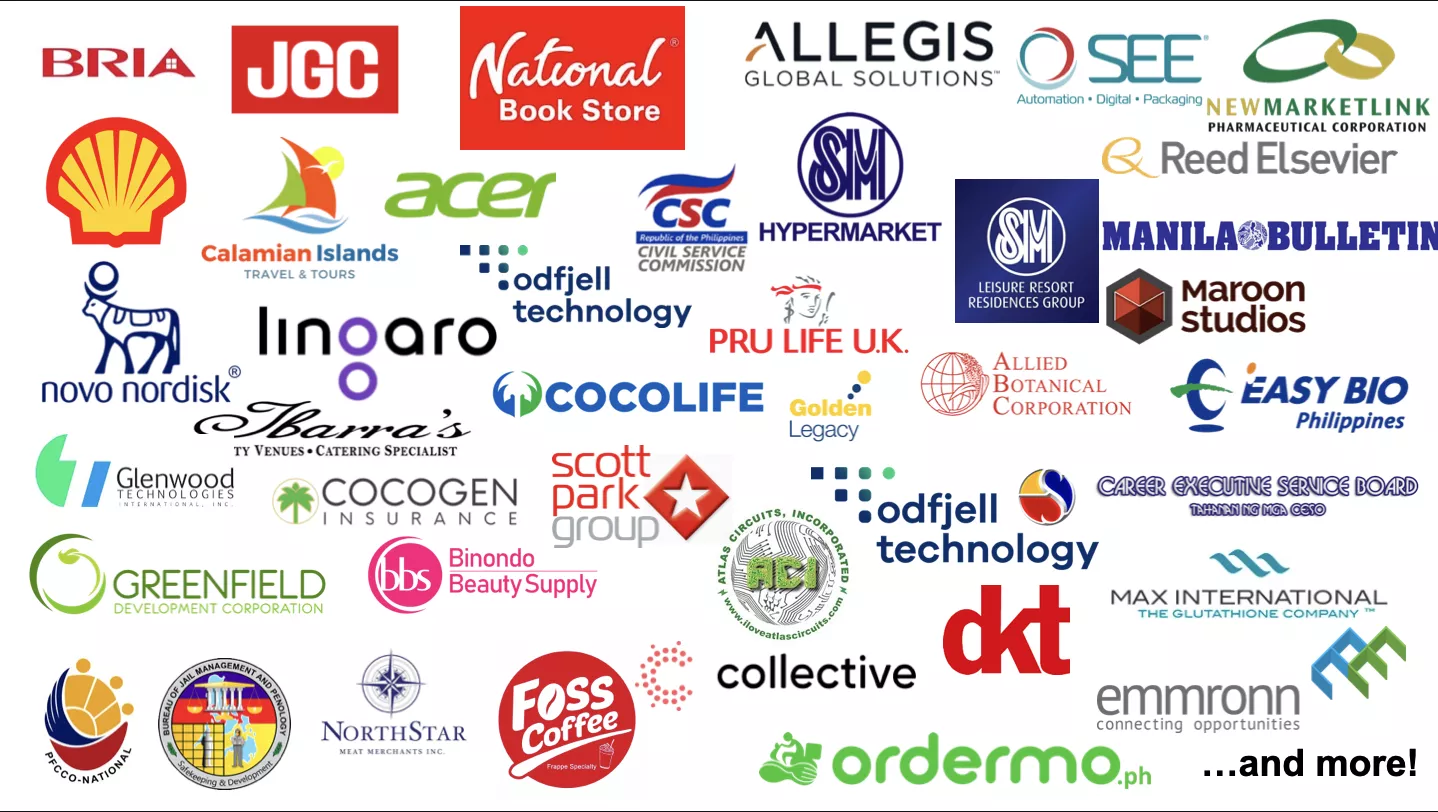
Leaders From Brands We’ve Trained

What is Change Management?
Change management is a corporate training program that teaches and trains participants how to deal with internal and external changes in the company or organization, either due to transitions in the management, change of policies and systems, or adaptation to new technologies.
In practice, change management is the structured approach an organization uses to move people from how they work today to how they need to work tomorrow. Project management delivers the new system, the new structure, or the new policy. Change management is what makes people actually use it. That gap is where most transformation budgets are lost.
Change Management Models We Teach
We don't teach one methodology and force every situation into it. Participants learn five proven models and, more importantly, when to use each one.
Kotter's 8-Step Model
John Kotter’s model moves an organization through eight sequential steps: create urgency, build a guiding coalition, form a strategic vision, enlist a volunteer army, remove barriers, generate short-term wins, sustain acceleration, and institute change.
We use it when: the change is large, visible, and enterprise-wide – a merger, a restructuring, or a new operating model. It is the strongest framework for building momentum across many departments at once.
The ADKAR Model
ADKAR breaks individual change into five building blocks: Awareness of the need, Desire to participate, Knowledge of how, Ability to apply, and Reinforcement to sustain. Change succeeds one person at a time.
We use it when: adoption is stalling and you need to diagnose exactly where. A team stuck at Desire needs a different intervention than a team stuck at Ability, and ADKAR tells you which one you have.
Lewin's Three-Stage Model
Kurt Lewin’s unfreeze-change-refreeze model is the foundation most other frameworks build on. Paired with Force Field Analysis, it maps the driving forces pushing change forward against the restraining forces holding it back.
We use it when: teams need a simple, teachable mental model, or when a change has stalled and you need to see clearly which restraining forces to weaken first.
Bridges' Transition Model
William Bridges separates change (the external event) from transition (the internal, psychological process people go through). It has three phases: an ending and letting go, a disorienting neutral zone, and a new beginning.
We use it when: the change is emotionally loaded – layoffs, leadership turnover, office closures, or role redesign. It gives leaders language for what their people are feeling and permission to address it directly instead of rushing past it.
McKinsey 7-S Framework
The 7-S Framework examines seven interdependent elements: strategy, structure, systems, shared values, style, staff, and skills. Change one and the others must realign or the organization pulls itself back to where it started.
We use it when: assessing readiness before a change begins, and when diagnosing why a previous initiative failed to stick. It is the diagnostic we open most engagements with.
Adapting to Market Needs
While adaptability seems basic and simple to understand, it goes deeper than the definition. Our change management training empowers your professionals to deepen their knowledge of adapting to changes. Here’s what we usually cover in our change management training program:
Understanding Market-Driven Change
Organizations must recognize the forces driving transformation to maintain their competitive edge. Without this recognition, it’s impossible to take actions that correlate with ever-changing needs (or determine whether there’s a need for transformation). We help participants identify internal and external sources of dissatisfaction that indicate the need for change. We use the McKinsey 7-S Model to evaluate the organization’s readiness for change, which helps them balance demand vs. capability to align all their operational strengths with market opportunities.
Developing a Change Plan
A well-structured plan helps build clarity, minimizes uncertainty, and ensures successful execution. The participants may know all the “how-tos,” but without clear change objectives, they won’t be able to align their actions with both short-term goals and long-term vision, completely wasting their resources. We help them use frameworks such as the Kanban method to visualize progress, manage workflow, and ensure accountability among themselves. We also help them apply evolutionary change principles for gradual and more sustainable implementation, so they can build a lifestyle and truly behavioral change needed to adapt to changes.
Overcoming Resistance to Change
Resistance is a natural response to change, making it crucial to manage stakeholder expectations effectively. It’s a normal process every organization experiences, so knowing how to build a culture of effective communication is essential to maintaining clarity, alignment, and transparency. We help participants address some emotional barriers that come with too much stress and the inability to cope with transitions. Part of resistance management is gaining ‘buy-ins’ from leadership and teams so they can also adopt new initiatives. We help them promote more personal discipline and adaptability that starts with themselves and transfers the same energy to other stakeholders needing the change.
Participants learn to separate the five most common sources of resistance – unclear reason for change, fear of losing status or competence, distrust of leadership, change fatigue, and genuine disagreement with the plan – because each one calls for a different response.
Implementing Change Strategies
The successful execution of change initiatives determines the long-term impact on the organization. We help participants use change initiatives to engage their employees better and promote proactive involvement. This is where the real action is and how they can apply change management theories, principles, and frameworks. We walk them through how to use continuous discovery methods to refine change approaches based on real-time insights. Timing is important in change management, so knowing how they communicate things at the right time is a key transition phase they need to consider for maximum impact.
Who Should Attend Change Management Training
Change management training works best when the whole chain of influence attends, not just the executive team.
Executives and Change Sponsors
Presidents, COOs, business unit heads, and entrepreneurs who authorize the change and are accountable for the outcome. They set the vision, fund it, and are visible throughout. When sponsors go quiet, change stalls.
Managers and Supervisors
Department managers, team leads, and supervisors who deliver the message and absorb the pushback. This is the group that determines whether change succeeds, and the group most often skipped in training budgets.
HR and L&D Teams
HR business partners, OD practitioners, and learning and development leads who design the people side of transformation and support managers through it.
Project and Program Managers
PMO leads and project managers running system migrations, process redesigns, or ISO implementations who need adoption, not just on-time delivery.
Change Champions
Influential individual contributors nominated to carry the change into their teams. Peers often listen to them before they listen to management.
Affected Employees
Rank-and-file staff going through a transition who need practical tools for adapting, managing stress, and staying productive during uncertainty.
Importance of Change Management
While you may face a high-level of resistance, change management will always be as apparent and essential for all organizations. Here are more compelling reasons and benefits why you need to conduct change management for your company:
Transitions
Transitions aren’t easy. When someone leaves or new management comes, it doesn’t come quickly for all employees working for the company. It requires a change in behavior acceptance, and all these things must be settled and prepared even before the transition happens. Let alone having all the technologies coming to your organization. There must be a change management training that deals with just that.
Harmony and Dynamics
Teams with proper transitions and the ability to adapt to the market's ever-changing needs can better work among themselves. Thus, it improves the harmony and dynamics of the entire workforce. With change management training, effective communication is an integral part of the content outline. Participants must know how to effectively communicate to their teams any necessary instruction or know-how regarding the change happening and what, when, and how to manage this change.
Skills and Organizational Advancement
As for all the teams harnessing their skills and power in managing change, there is advancement and progress to expect in the organization. Leaders from the top are more confident in dealing with various challenges, and this confidence and competence are passed onto every member of the organization. They result in a more cohesive and advanced approach to growing each department and organization.
Stress Management
When transitions are correctly executed, the negative is reduced. Of course, some challenges must be faced, but dealing with them properly allows for smooth and better team behavior. Instead of blaming each other or conflicting with each other shoes, they are more cooperative and adaptable to any internal or external change happening (or recurring) within the company.
Benefits of Our Change Management Program
While you may face a high-level of resistance, change management will always be as apparent and essential for all organizations. Here are more compelling reasons and benefits why you need to conduct change management for your company:
Strengthening Leadership in Change
Change management starts with leaders. If leaders know how to navigate changes, it’s easy for them to pass on this same energy and outlook so their teams can also adapt to changes. Effective leadership is key to guiding teams through transformation. We help train your change managers to lead confidently and clearly during transitions, using frameworks such as the McKinsey 7-S Model, Lean 5S principles, the ADKAR model, and other frameworks to streamline workflows, improve efficiency, and reduce waste.
Enhancing Employee Adaptability
For change to succeed, employees must develop the right mindset and skill set. As change management starts with leaders, it will be passed on to employees. We help our participants, the change influencers in your organization, with stress management techniques to navigate uncertainty and reduce anxiety. Personal care and discipline are needed to adapt, take ownership, and have full personal accountability. Without these core vitals, you won’t train your employees at the optimal level of transition management. We also help your rank-and-file level employees better communicate with colleagues to build teamwork and support smooth transitions.
Measuring the Impact of Change
Tracking change effectiveness ensures that initiatives produce tangible, long-term benefits. We help your participants establish key performance metrics to evaluate the transition and change management’s success and identify improvement areas. The metrics we help teams set include adoption rate, proficiency against the new process, employee sentiment during and after rollout, speed to competency, and benefit realization against the original business case. We also use organizational advancement strategies to maintain momentum and integrate improvements. For instance, one of the best change management strategies is applying feedback loops to refine processes based on team and stakeholder insights.
Sustaining Long-Term Success
Change should not be a one-time effort but a continuous journey toward growth and innovation. By intentionally developing rooms for positive behaviors and skills, we can help you build a culture of constant learning that promotes long-term adaptability. Strategic planning also drives sustainability, which anticipates future industry shifts, adjusts strategies, and prepares accordingly. We help your participants align change strategies with business objectives, ultimately achieving long-term success.
Change Management in the Philippine Context
Global frameworks are sound. What they miss is how change actually moves through a Filipino organization. Our case work is built for this market.
Resistance Is Often Silent, Not Loud
In many Filipino workplaces, disagreement rarely surfaces in the room. Teams nod in the town hall and revert to the old process the following week. Leaders trained on Western models look for open objection and see none, so they assume alignment. We teach leaders to read the quieter signals: hedged commitment, delayed compliance, questions routed through intermediaries, and the difference between agreement and pakikisama.
Transitions We See Most Often
- BPO and shared services restructuring, automation, and reskilling at scale
- Succession and professionalization in family-owned businesses
- Return-to-office and hybrid work mandates
- ERP, HRIS, and core system migrations
- Mergers, acquisitions, and new ownership
- ISO certification and process standardization
- Leading multigenerational teams where Gen Z and tenured staff read the same change differently
Training Formats and Delivery Options
Every engagement is scoped to your organization. Choose the format that fits your team, your calendar, and your budget.
In-House Onsite
Delivered at your office or a venue of your choice, anywhere in the Philippines. Content, cases, and exercises are built around your actual transition. This is our most requested format.
Best for: intact leadership teams, 15 to 30 participants.
Live Online
Instructor-led sessions via Zoom or Microsoft Teams, run in shorter blocks across multiple days to protect operations. Breakout rooms, live polls, and workbook exercises keep it participative.
Best for: distributed teams and regional offices.
Blended Program
Workshop plus follow-through: a 30-day check-in, a 60-day clinic, and coaching for the change leads. Built for transitions that run over months rather than days.
Best for: organizations in the middle of a live transformation.
Executive Coaching
One-on-one sessions for the change sponsor or executive leading the transition, focused on their specific decisions, stakeholders, and communication moments.
Best for: individual leaders carrying a high-stakes change.
Change Management Training Cost
Change management training in the Philippines typically runs between Php 10,000 and Php 250,000 per engagement. Here is what drives where you land in that range.
| Format | Typical Duration | Indicative Investment |
|---|---|---|
| Executive briefing or lunch session | 2 to 3 hours | Php 10,000 to Php 45,000 |
| Half-day in-house workshop | 4 hours | Php 45,000 to Php 90,000 |
| Full-day in-house program | 8 hours | Php 90,000 to Php 160,000 |
| Two-day LeaderShift program | 16 hours | Php 160,000 to Php 250,000 |
| Blended program with follow-through | Multi-month | Quoted on scope |
What is included: training needs analysis, customized content and case scenarios, facilitator fee, participant workbooks, digital handouts, certificates of completion, and a post-training summary report for the sponsor.
What moves the price: number of participants and batches, venue and travel outside Metro Manila, depth of customization, whether pre-training diagnostics or post-training coaching are included, and the seniority of the group.
Pricing is quoted per engagement, not per head, so cost per participant drops as batch size increases.
How Our Engagement Works
From first inquiry to reinforcement, here is exactly what working with us looks like.
1. Inquiry
You send us the transition you're facing and your target dates. We reply within one working day.
2. Needs Analysis
A short discovery call plus a participant survey to find the real gap. Use our free training needs analysis template to prepare.
3. Proposal
You receive a customized outline, objectives, duration, format, and a fixed quotation. No surprises later.
4. Delivery
Facilitated onsite or live online, using your own change scenarios as the working material throughout.
5. Reinforcement
A sponsor report, participant action plans, and an optional 30 and 60-day check-in so the learning holds.
What Participants Receive
Included in every change management training engagement.
- Participant workbook with all frameworks, worksheets, and exercises used in session
- Digital handouts and slide deck for reference after the program
- Change plan template and stakeholder map they complete during the workshop
- Communication plan worksheet for their specific transition
- Certificate of completion issued by Rainmakers Training and Consultancy
- Personal 90-day action plan drafted before they leave the room
- Sponsor summary report covering participation, themes raised, and recommended next steps
Where We Deliver Change Management Training
We deliver change management training onsite across the country, and live online anywhere.
Metro Manila: Makati, Bonifacio Global City, Ortigas, Quezon City, Pasig, Alabang, Manila, Parañaque, Mandaluyong, Taguig
Luzon: Clark and Angeles, Baguio, Batangas, Laguna, Cavite, Bulacan, Pampanga
Visayas and Mindanao: Cebu, Iloilo, Bacolod, Davao, Cagayan de Oro, General Santos
Nationwide and regional: live online delivery anywhere in the Philippines, plus ASEAN engagements on request.
If your team is spread across sites, we can run a single live online batch or travel to each location. Both are quoted transparently in the proposal.
Adapt To The Ever-Changing Market Needs With Change Management Training
Are you struggling to manage change effectively within your organization in the Philippines?
Do you find yourself constantly putting out fires and dealing with resistance from employees?
Are you tired of seeing projects fail due to a lack of buy-in from your team?
At Rainmakers Training and Consultancy, we understand the pain of managing change. We’ve seen firsthand how it can agitate even the most dedicated and hardworking teams.
But there is a solution. Our change management training program is specifically designed for leaders in the Philippines.
Through our program, you’ll learn the skills and strategies to communicate effectively and implement change within your organization.
Quick Guide to Change Management Training in the Philippines
Learn more about change management skills in the Philippines.
We run change management training in three standard lengths:
- Half day (4 hours) – awareness level. Covers what change management is, why initiatives fail, and the core models. Good for executive briefings or a large all-hands.
- One day (8 hours) – working level. Adds change planning, communication, and resistance management with hands-on exercises. Our most common format.
- Two days (16 hours) – full LeaderShift program. All five modules, with participants leaving with a drafted change plan, communication plan, and measurement scorecard for a live initiative.
We also run blended programs that spread sessions across weeks with coaching in between, which works better when you are in the middle of an active transition.
Both. We deliver in-house onsite at your office or venue anywhere in the Philippines, and live online through Zoom or Microsoft Teams. Online sessions are run in shorter blocks across multiple days rather than one long stretch, with breakout rooms and workbook exercises so it stays participative. Hybrid delivery, where part of the group is in the room and part is remote, is also available. Many clients combine an onsite session for the leadership team with live online batches for regional sites.
The program covers five models and, more importantly, when to use each one: Kotter’s 8-Step Model for large enterprise-wide change, the ADKAR model for diagnosing where individual adoption is stalling, Lewin’s three-stage model and Force Field Analysis as the foundational mental model, Bridges’ Transition Model for emotionally loaded change, and the McKinsey 7-S Framework for readiness assessment. We also draw on the Kanban method and Lean 5S principles where the change involves process and workflow. Which models get the deepest treatment depends on the transition your organization is going through.
Yes. Every participant receives a certificate of completion issued by Rainmakers Training and Consultancy. Note that this is a certificate of completion for a customized corporate program, not an exam-based professional credential like Prosci or CCMP. If your requirement is a globally examined certification, we will tell you that directly and point you to the right provider. If your requirement is that your leaders can actually run the transition in front of them, that is what we are built for.
It depends on the outcome you need.
Choose a certification track (Prosci, CCMP, Change Management Foundation and Practitioner) when an individual needs a portable, globally recognized credential on their CV, when a client or regulator requires certified practitioners, or when you are building a formal internal change practice with a standard methodology.
Choose an in-house customized program when you have a specific transition happening now, when you need a whole leadership team aligned quickly rather than individuals credentialed slowly, when budget is better spent on twenty leaders than on two certifications, and when the content needs to reflect your industry, your culture, and your actual change.
Many organizations do both: certify one or two internal change leads, then run in-house programs to cascade capability across the management layer.
Effective change management is crucial for corporate leaders aiming to navigate organizational transformations successfully. Here are some top change management training programs tailored for corporate leaders:
- LeaderShift by Rainmakers – a leadership-focused change management program designed to help executives and managers lead teams through transition with confidence and clarity.
- Kotter’s 8-Step Change Model Workshop
- Prosci Change Management Certification (custom versions for leadership teams)
- Leading Change by John Kotter (Harvard framework-based executive training)
Selecting the right corporate training provider for change management in the Philippines is crucial for ensuring effective organizational transformation. Here are some notable providers offering specialized programs in this area:
- Rainmakers Training and Consultancy
- Benchmark Consulting
- Haraya Coaching
- Salt and Light Ventures
- BusinessWorks Inc.
Selecting the right change management course is crucial for executives aiming to lead successful organizational transformations. Here are some top-rated programs tailored for executive leaders:
- LeaderShift by Rainmakers – focuses on real-time organizational shifts and equipping leaders with tools to manage change strategically.
- Leading Change and Organizational Renewal (Stanford/Harvard)
- INSEAD Leading Change Program
- Prosci Executive Sponsor Briefing (custom executive version)
Enhancing leadership skills through change management training is crucial for effectively guiding organizations through transitions. Here are several highly recommended programs:
- LeaderShift by Rainmakers – integrates leadership development and change execution techniques.
- Change Leadership Masterclass by IMD
- Change Management and Leadership by CCL (Center for Creative Leadership)
- McKinsey’s Organizational Change Leadership Program
Several leading change management training providers offer personalized programs tailored to organizational needs:
- Rainmakers Training and Consultancy – customizes LeaderShift based on industry, leadership level, and transition goals.
- Guthrie-Jensen Consultants
- Breakthrough Leadership
- Haraya Coaching
- Human Capital Asia
When evaluating top change management training programs, it’s essential to consider their content focus, delivery methods, prerequisites, costs, and overall effectiveness. Here’s a comparison of some leading programs:
- LeaderShift by Rainmakers – combines leadership strategy, communication, and execution models in Philippine and ASEAN business contexts.
- Prosci Certification – globally recognized, structured methodology, widely applicable.
- Kotter’s 8-Step Workshops – action-oriented, ideal for large-scale transformation.
- INSEAD’s Change Management Program – global case studies, academic-heavy, high investment.
Effective change management is crucial for leaders aiming to guide their organizations through transitions successfully. Here are several esteemed programs that focus on leadership development within the context of change management:
- LeaderShift by Rainmakers – emphasizes the link between leadership mindset and driving transformation.
- Leading Strategic Change (Wharton Executive Education)
- Navigating Organizational Change (MIT Sloan)
- Strategic Leadership in Times of Change (IMD)
Navigating organizational transitions effectively requires robust change management training. Here are some of the most effective programs available:
- LeaderShift by Rainmakers – practical program for leading transitions in hybrid, multigenerational workplaces.
- Prosci Change Management Certification
- The Change Factory’s Change Leader Program
- Harvard ManageMentor: Change Management
Several corporate training providers are renowned for their expertise in change management, offering comprehensive programs to equip organizations and individuals with the necessary skills to navigate and implement change effectively. Here are some notable providers:
- Rainmakers Training and Consultancy
- Haraya Coaching
- Human Capital Development Network
Enhancing team adaptability through effective change management is crucial for organizations navigating today’s dynamic business environment. Several highly regarded training programs can equip teams with the necessary skills to manage and adapt to change effectively. Here are some top-rated options:
- LeaderShift by Rainmakers – enables team leaders to foster adaptability and psychological safety during change.
- Prosci Team Member Change Sessions
- ADKAR Awareness and Engagement Workshops
- Agile Change Management Training
LeaderShift Training is geared towards dealing with the day-to-day challenges leaders and organizations face brought about by the disruption of today’s world.
Our change management training program focuses on three essential pillars:
- Personal Discipline
- Continuous Discovery
- Intentional Development
Personal Discipline
This pillar deals with the fundamentals of skills, knowledge, and actions.
To disrupt yourself in today’s overwhelming distractions, you must go back to basics. Have the discipline to be good at where you’ve started so you can invest yourself in advanced learning.
Continuous Discovery
In this next pillar, we focus on different advancements toward discovery. It includes understanding the latest trends and technologies to adapt to the ever-changing market landscape.
In Discovery, you’ll learn how to adapt and be flexible, giving you an unfair advantage to new opportunities every day.
Intentional Development
In this pillar, you bridge the gap between where you are and where you want to go.
Growth is the objective of this pillar. Here, you’ll find different tools and strategies for personal development.
Intentionality matters as one grows with the right attitude, behavior, and actions.
Yes. Top leaders must be the first to attend this change management training program.
Organizational change depends on how top to mid-level leaders appreciate and accept change. It is where the next steps of action come from.
With the acceptance of change, executives and entrepreneurs can adapt quickly to the changing environment.
Change management training program costs between Php10,000 to Php250,000.
It depends on the training needs and objectives of the organization. The cost depends on the value provided by the corporate trainers and speakers.
As a guide: a 2 to 3 hour executive briefing typically runs Php 10,000 to Php 45,000, a half-day workshop Php 45,000 to Php 90,000, a full-day program Php 90,000 to Php 160,000, and the full 2-day LeaderShift program Php 160,000 to Php 250,000. Quotations are per engagement rather than per head, so cost per participant falls as batch size rises.
Change management training program is important in the Philippines because they can help leaders and organizations navigate the constantly evolving business landscape.
With new strategies and tools, attendees of change management training programs will be able to adapt to new market conditions.
There is also a local dimension. Philippine organizations are running unusually dense change agendas right now: BPO and shared services reskilling as work shifts from clerical to knowledge-based, succession and professionalization in family-owned businesses, hybrid and return-to-office mandates, and a wave of ERP and HRIS migrations. Add to that a workplace culture where disagreement is often expressed indirectly, and leaders need to be trained to read resistance that never gets said out loud.
Some common topics covered in change management training in the Philippines include personal change management, change management models, how to manage change resistance, and how to communicate change across the organization.
A complete program will usually also cover readiness assessment, stakeholder mapping, change impact analysis, communication planning, change roles such as sponsor and change champion, measurement and adoption metrics, and reinforcement so the change survives past go-live.
Change management training is designed for managers, supervisors, leaders, and others responsible for leading teams through change.
Attendees will be able to experience changes in processes, systems, technologies, and culture. And by having first-hand experiences, participants of the change management program will benefit from it, not only for professional context but also for personal purposes.
In practice the strongest results come when the full chain attends: the executive sponsor, the managers and supervisors who deliver the message, HR and L&D, project or program managers, nominated change champions, and where relevant the affected employees themselves.
There are a few established corporate trainers and speakers who do effective change management training programs online.
Diligently research and filter ones with a proven track record. You may also ask for recommendations from your networks, mentors, and friends in the industry. This will help you enlarge your list to find the most suitable corporate trainer for your change management training program.
When shortlisting, ask each provider four questions: will you customize the content to our actual transition, which change models do you teach and why, what happens after the workshop to reinforce it, and can we speak to a client who ran a similar change.

