What is Design Thinking Training?
Design Thinking is a human-centered, problem-solving framework used to generate innovative solutions by deeply understanding user needs. The methodology focuses on empathy, creativity, and experimentation over rigid procedures.
It gained traction through the work of Stanford University and the design firm IDEO, which led to many organizations using the framework in their internal work. The process fosters creative confidence, empowering Filipino professionals to explore and test ideas without fear of failure.
By encouraging a human-centric design and problem-solving mindset, Design Thinking helps Filipino teams adapt more quickly and innovate more effectively in a fast-paced business environment.
If you’re interested in bringing our signature Design Thinking training program, please fill out our training form, and we’ll schedule a complimentary training needs analysis session with your team.
Design Thinking Training Program at a Glance
Everything decision-makers ask before requesting a quote, in one place.
| Program name | Design Thinking and Innovation |
| Delivery formats | In-house onsite, live online (virtual instructor-led), or hybrid |
| Duration options | 1 full day, 2 full days, or 4 half-day sessions |
| Ideal group size | 15–25 participants per batch |
| Level | Beginner to intermediate — no design background required |
| Delivery language | English, with Filipino used for discussion and coaching |
| Locations | Metro Manila, Cebu, Davao, and nationwide onsite; live online anywhere |
| Customisation | Modules, cases, and exercises built around your industry, roles, and a live business challenge |
| Before the program | Complimentary Training Needs Analysis (TNA) session with your team |
| Materials | Participant workbook, design thinking template pack, digital collaboration board |
| Completion | Certificate of Completion issued to each participant |
| Investment | Quoted per engagement after the TNA — request a free quote |
Swipe the table sideways to see all details.
Philippines' Top Design Thinking Training Provider: Our Impact, Told By Those Who've Experienced It
As a premier design thinking training provider in the Philippines, our impact is best conveyed through the experiences of our clients.


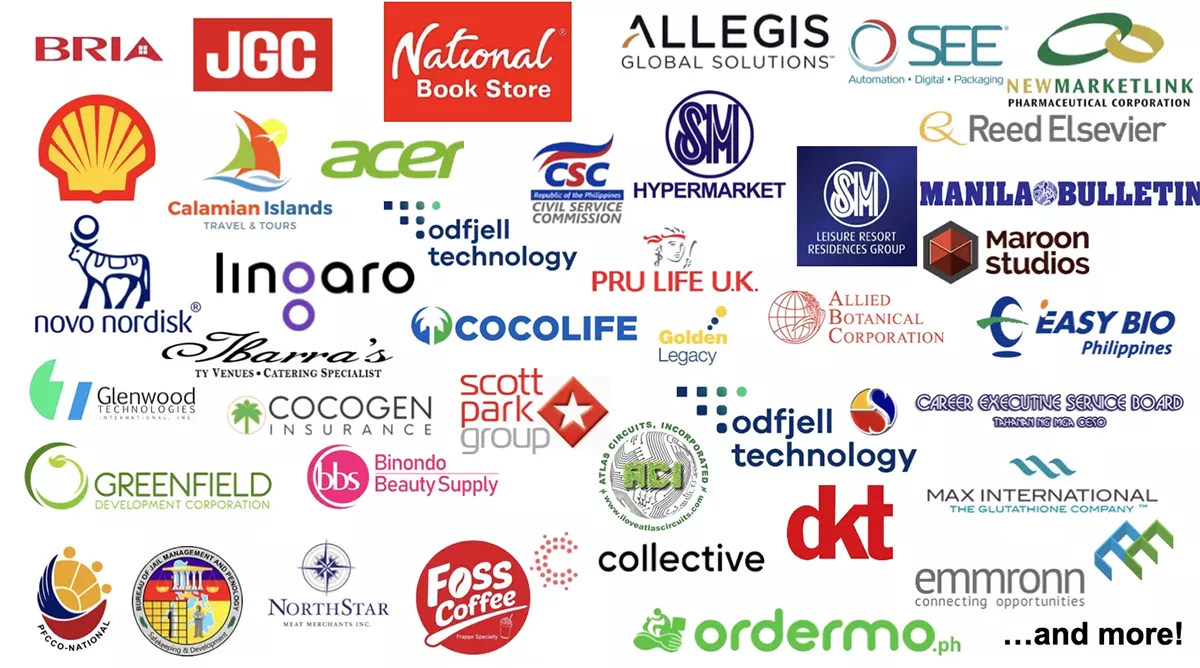
Leaders From Brands Trained By Rainmakers, The Top Design Thinking Training Provider in the Philippines
The 5 Stages of Design Thinking
Our design thinking training in the Philippines follows the five-stage model developed at the Hasso-Plattner Institute of Design at Stanford (d.school) and popularised by IDEO. The process is iterative — teams move back and forth between stages as new insights emerge.
| Stage | What Your Team Does | Tools We Teach | Output |
|---|---|---|---|
| 1Empathize | Set assumptions aside and understand the people you serve — customers, employees, or citizens — through direct research. | Empathy interviews, empathy map, observation and shadowing, customer journey map | Validated user insights and pain points |
| 2Define | Synthesise research into the real problem worth solving, instead of the symptom that was first reported. | Affinity clustering, 5 Whys, root cause probing, Point of View (POV) statement, How Might We questions | A clear, human-centered problem statement |
| 3Ideate | Generate a high volume of ideas without judgment, then narrow to the concepts worth building. | Structured brainstorming, Crazy 8s, SCAMPER, worst possible idea, dot voting, impact–effort matrix | A prioritised shortlist of solution concepts |
| 4Prototype | Make the idea tangible fast and cheaply, so it can be reacted to rather than only discussed. | Paper prototypes, storyboards, wireframes, service blueprints, role play and simulation | A low-fidelity, testable prototype |
| 5Test | Put the prototype in front of real users, capture honest feedback, and iterate before committing budget. | Usability test script, feedback capture grid, iteration log, pilot planning | A refined solution and a clear next-step plan |
Swipe the table sideways to see the full process.
The stages are modes, not a checklist. Teams often run Empathize and Define together, or return to Ideate after a failed test — which is exactly what we rehearse during the workshop.
What Your Team Will Learn
By the end of our design thinking training, your participants will be able to:
- Explain what design thinking is, where it came from, and when it is the right tool for a business problem.
- Run empathy interviews and translate what customers or employees actually say into usable insight.
- Build empathy maps and customer journey maps that expose pain points teams normally miss.
- Separate root causes from symptoms and write a problem statement the whole team agrees on.
- Facilitate a structured ideation session that produces volume first and judgment second.
- Prioritise ideas using impact–effort and feasibility criteria rather than seniority or volume.
- Build a low-fidelity prototype in under an hour using materials already in the office.
- Plan and moderate a user test, capture feedback without leading the participant, and iterate.
- Apply the full five-stage process to a real challenge from your own organisation during the workshop.
- Bring design thinking back to the team through a written 30-day application plan.
Design Thinking Training Course Outline
A working outline of our in-house program. Every module is re-scoped against your TNA findings before delivery.
| Module | Focus | Key Activities |
|---|---|---|
| 1. Foundations of Design Thinking | What design thinking is, human-centered design, when to use it versus conventional problem solving, and the mindset shifts required | Framing discussion, creative confidence exercise, case walkthrough |
| 2. Empathize | Gathering real user insight from customers, employees, or citizens | Empathy interview practice, empathy mapping, journey mapping on a live challenge |
| 3. Define | Turning research into the right problem statement | Affinity clustering, 5 Whys, drafting POV and How Might We statements |
| 4. Ideate | Generating and prioritising solution concepts as a cross-functional group | Facilitated brainstorming, Crazy 8s, dot voting, impact–effort mapping |
| 5. Prototype | Making ideas tangible quickly and cheaply | Rapid paper prototyping, storyboarding, service blueprint sketch |
| 6. Test & Iterate | Validating with real users and refining before investment | Test script writing, moderated peer testing, feedback grid, iteration round |
| 7. Embedding Design Thinking at Work | Making the method stick after the workshop ends | Team presentation of solutions, barriers discussion, 30-day application plan |
Swipe the table sideways to see all modules.
Design Thinking Tools and Templates We Teach
Participants leave with the templates, not just the theory. Every tool below is practised on a live challenge during the workshop.
| Tool | What It Is For | Stage |
|---|---|---|
| Empathy Map | Captures what a user says, thinks, does, and feels in one view | Empathize |
| Customer Journey Map | Plots the full end-to-end experience and where it breaks down | Empathize |
| Persona | Turns research into a shared, memorable profile of who you are designing for | Empathize |
| Stakeholder Map | Identifies everyone affected by the problem and who must be consulted | Empathize |
| 5 Whys | Drills past the reported symptom to the underlying root cause | Define |
| Point of View (POV) Statement | States the problem in the form: user + need + insight | Define |
| How Might We (HMW) | Reframes the problem as an open invitation to generate solutions | Define |
| Crazy 8s | Forces eight ideas in eight minutes to break fixation on the first answer | Ideate |
| Impact–Effort Matrix | Prioritises ideas objectively instead of by seniority or volume | Ideate |
| Paper Prototype | Makes a concept testable in minutes at near-zero cost | Prototype |
| Service Blueprint | Maps the front-stage and back-stage of a service so gaps become visible | Prototype |
| Usability Test Script | Structures a user test so feedback is honest and not led | Test |
| Feedback Capture Grid | Sorts test feedback into likes, criticisms, questions, and new ideas | Test |
Swipe the table sideways to see every tool.
Why Design Thinking Matters in the Philippine Workplace
Design thinking is now a critical skill for many Filipino professionals as they shift from reactive problem-solving to strategic and proactive innovation. In the Philippine context, the framework addresses specific workplace challenges, including but not limited to customer retention, employee engagement, and public service redesign.
Service Innovation in Filipino BPOs
The BPO sector in the Philippines heavily relies on process efficiency and delivering excellent customer service. As client expectations evolve, standard interaction scripts and rigid workflows are no longer enough. With that, design thinking can help introduce new human-centered solutions to elevate services, especially in high-volume contact centers.
Local MSMEs Solving Customer Pain Points
Micro, small, and medium enterprises (MSMEs) comprise over 90% of registered businesses in the Philippines. Business owners of this type often face brutal competition from conglomerates, let alone having limited resources. Design thinking training can empower these MSME owners to gain a deep understanding of their customers and test new, creative ideas quickly before scaling growth.
Government-Led Citizen-Centered Programs
Government agencies and local government units (LGUs) in the Philippines are now adopting more people-first approaches in delivering public services. Design thinking methodologies can equip these public servants with frameworks to uncover unmet citizen needs and co-design better systems for their organizations.
Educational Institutions Designing Better Learning Experiences
Filipino educators are using design thinking frameworks to reframe learning from content delivery to student engagement. It also empowers schools to co-create learning environments with students, teachers, and parents. For instance, you can use design thinking frameworks to create empathy interviews with your students and design programs for increased community involvement.
Retail and E-Commerce Personalizing Customer Experience
As online shopping, deliveries, and hybrid retail models rapidly grow in the Philippines, leaders in companies are using design thinking frameworks to refine their customer journeys, making it more personalized, seamless, and intuitive. Their customer-first approach helps them develop and capture a bigger market share within their target location.
Design Thinking Applied in Filipino Workplaces
Concrete examples of how Filipino teams apply the five stages to problems they already have. We use scenarios like these to build your customised workshop challenge.
| Sector | Common Challenge | Design Thinking Application | What Changes |
|---|---|---|---|
| BPO & Shared Services | Repeat escalations and low CSAT despite full script compliance | Journey-map the escalation path, interview agents and end customers, prototype a revised handling flow | Fewer repeat contacts and a script agents can actually work with |
| MSMEs & Family Business | New products launched on instinct and slow to sell | Empathy interviews with 10 real buyers, POV statement, low-cost concept test before production | Cheaper mistakes and faster validation on limited capital |
| Government & LGUs | Long queues and repeat visits for permits and frontline services | Shadow citizens through the actual process, map every touchpoint, prototype a simplified flow | Fewer steps, clearer requirements, less frontline conflict |
| Banking & Fintech | Onboarding drop-off and low adoption of digital channels | Map the drop-off points, run HMW ideation, prototype and test alternative onboarding journeys | Higher completion rates and better first-use experience |
| Retail & E-Commerce | Cart abandonment and inconsistent online-to-store experience | Journey map across channels, test checkout and pickup prototypes with real shoppers | A seamless path from browse to delivery or pickup |
| Manufacturing & Operations | Recurring defects and process workarounds on the floor | Empathise with operators, use 5 Whys to reach root cause, prototype the fix on one line first | Fixes that hold because operators helped design them |
| Healthcare | Patient confusion and long waiting experience | Map the patient journey from arrival to discharge, co-design signage and flow with staff | Calmer flow and fewer avoidable complaints |
| HR & People Teams | Engagement programs with low participation | Employee empathy interviews, employee journey map, pilot one small initiative before rollout | Programs employees opt into rather than tolerate |
Swipe the table sideways to see every sector.
Who Should Attend Our Design Thinking Training in the Philippines
Design thinking training caters to specific professionals who solve problems, develop new ideas, or improve systems as core tasks of their work. The following roles benefit the most from our Design Thinking training:
Marketing Managers
When launching new products, especially in competitive markets, it’s imperative to discern customers’ needs. Having a design thinking framework can help them understand real customer pain points through empathy interviews and rapid prototyping. This is the basis of their targeted marketing strategies, new product features, and brand engagement campaigns.
HR Officers or People and Culture Leaders
Rethinking employee engagement programs, particularly in this age where new generational challenges are what every company is currently facing. So, applying Design Thinking frameworks can help HR officers co-create programs with employees, identifying their needs and testing small initiatives before fully implementing them across the entire workforce within the organization.
Startup Founders or Product Owners
Generally, design thinking training helps business owners validate business ideas and strategies quickly, using few to limited resources, before fully implementing them. This helps avoid or prevent overlooked risks and negative consequences stemming from aggressive business decisions. Through strategic user testing, product owners can focus on features that truly matter to their customers, rather than simply following new trends.
Other Roles That Benefit From Design Thinking Training
| Role | Why Design Thinking Helps | Stage They Use Most |
|---|---|---|
| Operations & Process Improvement Leads | Fixes the process people actually use, not the one on the flowchart | Define |
| Customer Experience & Service Leads | Turns complaint data into redesigned service moments | Empathize |
| Team Leaders & Supervisors | Runs problem-solving sessions where the whole team contributes | Ideate |
| Product, IT & Software Teams | Builds features users need instead of features that were requested loudest | Prototype |
| Learning & Development Managers | Designs programs around real performance gaps and tests them small first | Test |
| Business Analysts & Agile Coaches | Adds user discovery upstream of the backlog | Empathize |
| Government & Public Sector Officers | Co-designs services with the citizens who use them | Define |
| Sales Leaders | Reframes the pitch around the buyer’s actual problem | Empathize |
Swipe the table sideways to see all roles.
Delivery Formats and Locations
We deliver design thinking training wherever your team is — onsite at your office, at a venue you choose, or live online.
| Format | Best For | Where |
|---|---|---|
| In-house onsite workshop | Intact teams solving a shared, real business challenge | Your office or venue — Metro Manila, Cebu, Davao, and nationwide |
| Live online (virtual instructor-led) | Distributed teams, multi-site companies, and regional offices | Anywhere, using a shared digital collaboration board |
| Hybrid | Teams with a mix of onsite and work-from-home participants | One venue plus remote participants joining live |
| Multi-batch rollout | Large organisations training several departments in sequence | Scheduled across sites over weeks or months |
| Executive briefing session | Leadership alignment before a full team rollout | Onsite or online, shortened format |
Swipe the table sideways to see all formats.
How Our Design Thinking Training Works
We do not sell a fixed course off a shelf. Every design thinking engagement starts with a free training needs analysis so the workshop solves a problem you actually have.
1
Discovery Call
We discuss the business problem, the team involved, the timeline, and what success would look like after the workshop.
2
Free Training Needs Analysis
We run a complimentary TNA with your team to confirm the real skill gap and identify the live challenge the workshop will solve.
3
Program Customisation
We rebuild the modules, cases, and exercises around your industry, your roles, and your challenge — then agree the schedule and format.
4
Workshop Delivery
Participants work the full five-stage process on your real challenge and present tested prototypes by the end of the session.
5
Application and Follow-Through
Each participant leaves with a 30-day application plan, and we report back to management on outcomes and recommended next steps.
Why Companies Choose Rainmakers for Design Thinking Training
Most design thinking courses in the Philippines are open-enrolment seminars. Ours is built for one company, one challenge, one team.
| Rainmakers In-House Program | Typical Open-Enrolment Course | |
|---|---|---|
| Starting point | Free Training Needs Analysis with your team | Fixed syllabus published in advance |
| Workshop challenge | A live problem from your own business | A generic case study |
| Participants | Your intact team, so decisions carry into work | Strangers from different companies |
| Content | Modules and examples rebuilt for your industry and roles | Same deck for every batch |
| Schedule | Set around your operations | Fixed public calendar dates |
| After the session | 30-day application plan plus a report to management | Certificate and end of engagement |
| Local context | Filipino workplace scenarios — BPO, MSME, LGU, retail, manufacturing | Imported global case material |
Swipe the table sideways to compare.
Design Thinking Training FAQs:
Design thinking training teaches teams a structured, human-centered method for solving problems: understand the user first, define the real problem, generate many ideas, build a rough prototype, and test it with real people before committing budget.
In a corporate setting it is usually delivered as a hands-on workshop rather than a lecture. Participants practise the method on an actual business challenge, using tools such as empathy maps, journey maps, and rapid prototypes, and leave with both the skills and the templates to run the process again.
The five stages, as defined by the Hasso-Plattner Institute of Design at Stanford (d.school), are:
- Empathize — understand the user through interviews and observation.
- Define — synthesise research into a clear problem statement.
- Ideate — generate a wide range of possible solutions.
- Prototype — build a quick, low-cost version of the best ideas.
- Test — validate with real users and refine.
The stages are not strictly sequential. Teams frequently loop back — a failed test often sends you to Ideate, and a surprising insight during Ideate can send you back to Define.
There is no single official seven-step model. Some organisations expand the five d.school stages into seven by adding an upfront framing step and a downstream implementation step — for example: define the challenge, research, ideate, prototype, choose, implement, and learn.
The underlying logic is identical to the five-stage model. The extra steps simply make explicit what happens before the workshop starts and after the prototype is validated. Our program covers both ends: we frame the challenge during the training needs analysis, and we close with an implementation and application plan.
“The 5 D’s” is an informal label rather than a standard framework, and different sources name the D’s differently — commonly Discover, Define, Develop, Deliver, and Deploy. It is usually a variation on the UK Design Council’s Double Diamond, which uses four phases: Discover, Define, Develop, and Deliver.
If you are comparing training providers, the practical thing to check is not the number of D’s or stages but whether the program has participants actually run empathy research, prototyping, and user testing on a real problem. That is what transfers back to work.
Corporate design thinking programs in the Philippines typically run anywhere from a half-day awareness session to a multi-day immersive workshop, depending on how much hands-on practice is included.
Our in-house program is available in one full day, two full days, or four half-day sessions. We recommend the format after the training needs analysis, based on the complexity of the challenge and how much prototyping and testing time your team needs.
No. Design thinking is a problem-solving method, not a visual design discipline. No prior design, UX, or technical experience is required.
Our sessions regularly include participants from operations, HR, sales, finance, customer service, and frontline supervision. Mixed, cross-functional groups usually produce the strongest results because they bring different views of the same problem.
Both. We deliver design thinking training onsite at your office or chosen venue anywhere in the Philippines — including Metro Manila, Cebu, and Davao — and as live, instructor-led online sessions for distributed teams.
Online delivery uses a shared digital collaboration board so empathy mapping, ideation, and prototyping stay hands-on rather than becoming a webinar. Hybrid setups are also supported for teams with a mix of onsite and remote participants.
Pricing for in-house corporate design thinking training depends on group size, program length, delivery format, and location. Public open-enrolment courses are usually priced per seat, while in-house programs are priced per engagement, which is generally more cost-effective once you are training a full team.
We quote after the free training needs analysis, so the price reflects the actual scope rather than a generic package. Contact us for a free quote.
Yes. Every participant who completes the program receives a Certificate of Completion from Rainmakers Training and Consultancy, which can be added to a CV or LinkedIn profile. For multi-batch rollouts we also provide a completion report to your HR or L&D team.
Yes — customisation is the default, not an add-on. After the training needs analysis we rebuild the cases, exercises, and examples around your sector and roles, whether that is BPO service design, MSME product validation, public service redesign, retail customer experience, or manufacturing process improvement.
Most importantly, the workshop runs on a live challenge from your own organisation, so what your team produces during the session is usable afterwards.
In the Philippines, several institutions offer top-tier corporate training programs in design thinking. Here are some notable options:
- Design Thinking and Innovation by Rainmakers – An in-house program that equips teams with human-centered problem-solving skills, ideation techniques, rapid prototyping, and user feedback integration—all customized for Filipino organizations.
- Creative Problem Solving Bootcamp by People Ignite – Focuses on cross-functional collaboration and real-time ideation.
- Design Innovation Lab by Breakthrough Leadership – Offers simulation-based learning and business model innovation exercises.
Design thinking is a valuable methodology for marketing managers aiming to foster innovation and develop customer-centric strategies. Here are some top design thinking training providers tailored for marketing professionals:
- Rainmakers Training and Consultancy – Their Design Thinking and Innovation program helps marketing teams reframe brand challenges, map customer journeys, and prototype new campaign strategies based on user insights.
- People Ignite – Offers market mapping and design sprints tailored for content and campaign planning.
- Breakthrough Leadership – Provides workshops for market research and ideation loops.
Design thinking is a valuable approach for HR leaders aiming to develop innovative, human-centered solutions to complex challenges. Here are some top courses tailored for HR professionals:
- Design Thinking and Innovation by Rainmakers – Includes modules on employee journey mapping, engagement redesign, and developing people-first programs within the organization.
- Human-Centered HR by People Ignite – Applies empathy mapping to onboarding and culture.
- People Design Workshop by Breakthrough Leadership – Helps HR leads craft responsive, need-based employee initiatives.
Design thinking is a human-centered approach to innovation, crucial for startup founders aiming to develop products and services that truly resonate with users. Here are some highly recommended design thinking training programs tailored for entrepreneurs:
- Design Thinking and Innovation by Rainmakers – Enables founders to validate assumptions, prototype MVPs, and adapt their value proposition quickly using real customer feedback.
- Startup Innovation Lab by People Ignite – Focuses on lean startup methodology combined with design thinking.
- Founders’ Design Sprint by Breakthrough Leadership – Offers intensive ideation and product fit sessions.
Design thinking workshops are invaluable for product owners aiming to foster innovation and develop user-centric products. In the Philippines, several reputable institutions offer such workshops tailored to enhance your skills:
- Design Thinking and Innovation by Rainmakers – Trains product leads in user research, persona development, experience flow mapping, and iterative testing for continuous product improvement.
- Product Innovation Bootcamp by People Ignite – Offers empathy-driven product planning and prioritization tools.
- Design Execution Lab by Breakthrough Leadership – Emphasizes validation and design operations.
Design thinking is a powerful methodology that fosters innovation and problem-solving by focusing on user-centric solutions. For corporate teams aiming to integrate this approach, several top-rated training providers offer specialized programs:
- Rainmakers Training and Consultancy – Their Design Thinking and Innovation program is tailored for team collaboration, inter-departmental workshops, and innovation pipeline development inside large organizations.
- People Ignite – Offers cross-functional team facilitation and service design workshops.
- Breakthrough Leadership – Trains corporate teams in co-creation, rapid ideation, and solution deployment.
Enhancing employee engagement through design thinking involves adopting a human-centered approach to address workplace challenges. Here are several courses tailored to equip HR professionals with the necessary skills:
- Design Thinking and Innovation by Rainmakers – Empowers HR teams to reimagine engagement programs, gather employee feedback effectively, and iterate on solutions that build culture and retention.
- Employee Experience Mapping by People Ignite – Uses design thinking to address retention and wellness.
- Engagement Innovation Framework by Breakthrough Leadership – Offers tools for initiative redesign and employee surveys.
Design thinking is a powerful methodology for fostering innovation and solving complex business challenges. Several highly regarded training programs can equip professionals with the skills to implement design thinking effectively. Here are some top-rated programs:
- Design Thinking and Innovation by Rainmakers – Teaches business leaders and teams how to define root problems, co-create with users, test multiple solutions, and align innovation with business value.
- Strategic Design Thinking by People Ignite – Focuses on high-impact solutions and cross-market innovation.
- Business Innovation Sprint by Breakthrough Leadership – Combines design frameworks with real-time decision making.
Improving customer experience through design thinking involves engaging in workshops that emphasize empathy, creativity, and iterative problem-solving. Here are some of the most effective workshops tailored for this purpose:
- Design Thinking and Innovation by Rainmakers – Guides teams through customer journey mapping, pain point discovery, and innovation prototyping for CX redesign.
- CX Reimagined Workshop by People Ignite – Focuses on brand moments and service recovery.
- User-Centric Innovation by Breakthrough Leadership – Trains frontline and back-office teams in continuous CX refinement.
Selecting the right design thinking training provider that offers customized programs is crucial for addressing your organization’s unique challenges and goals. Here are some top providers renowned for their tailored design thinking training:
- Rainmakers Training and Consultancy – Their Design Thinking and Innovation program can be customized by industry, team role, or project challenge—whether for internal culture, customer experience, or product design.
- People Ignite – Delivers modular, customizable innovation labs.
- Breakthrough Leadership – Offers pre-session diagnostics and flexible module selection for on-site and hybrid teams.
Related Training Programs
Design thinking works best alongside the other problem-solving and leadership skills your team needs. These programs are frequently paired with it.
| Program | Why Teams Pair It With Design Thinking |
|---|---|
| Problem Solving & Decision Making | Adds structured decision frameworks after design thinking surfaces the options |
| Root Cause Analysis | Strengthens the Define stage so teams fix causes rather than symptoms |
| Customer Service Training | Turns redesigned service journeys into frontline behaviour |
| Leadership Training | Equips leaders to sponsor innovation and protect early-stage ideas |
| Presentation Skills | Helps teams pitch prototypes and insights to decision-makers |
| AI Training | Accelerates research synthesis and concept generation within the process |
| Digital Marketing | Applies customer insight to campaigns and channel experience |
| Corporate Training Programs | See the full range of in-house programs we customise for Filipino companies |
Swipe the table sideways to see all programs.
Build A Culture of Innovation with Rainmakers' Design Thinking Training Programs
We customize in-house business training programs for your company. Contact us to schedule a training needs analysis (TNA) with your team.