Client case study
Three Days, One Shared Language Across Every Department
Ordermo bought three separate training topics. Its intake form revealed one problem underneath all three, so we delivered them as a single sequence to the whole company.
- Olongapo City
- 3 consecutive days
- 20 to 25 PAX
- February 2024
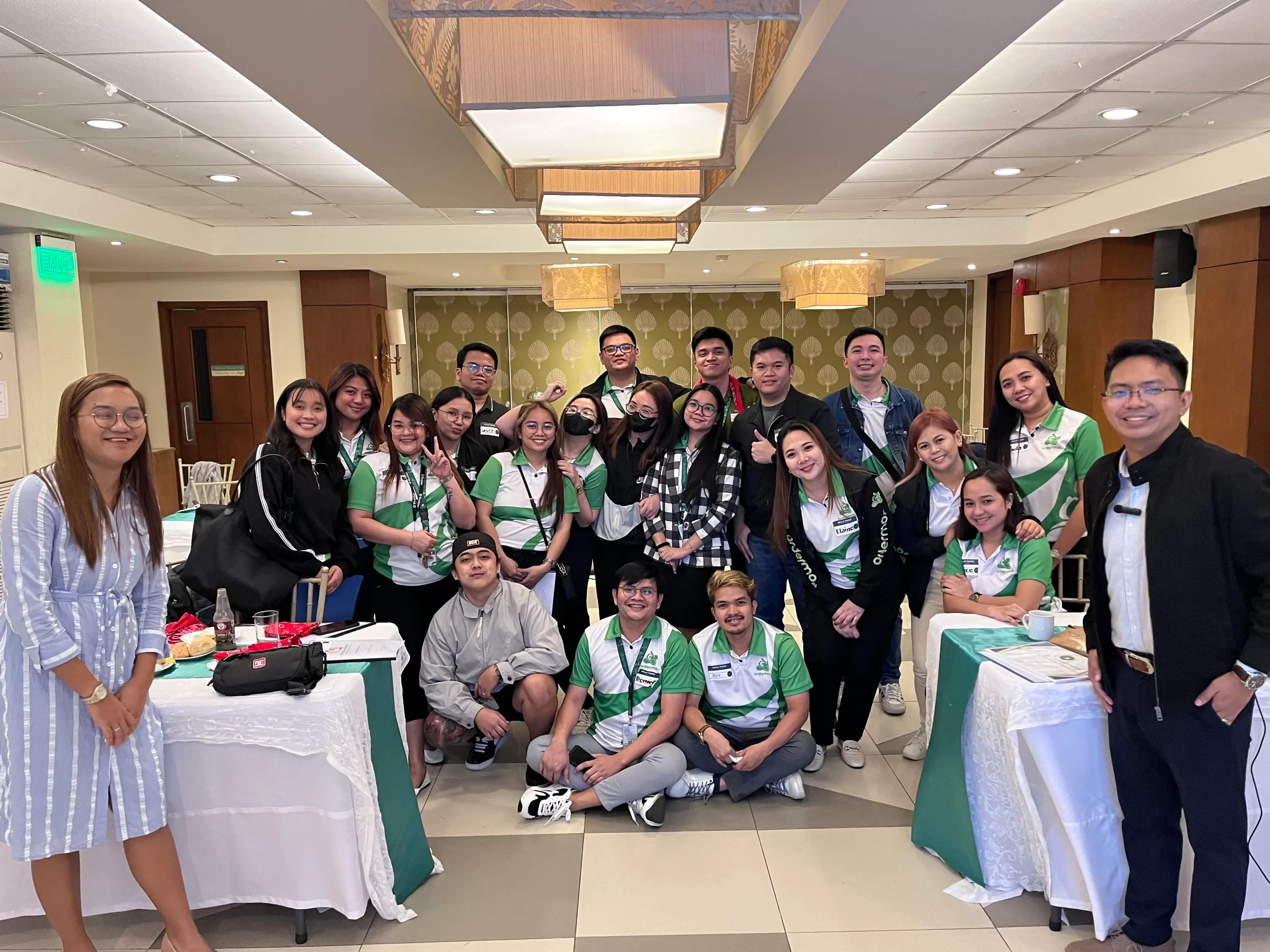
19 to 21 February 2024. Dispatchers, rider care, merchant success, marketing, graphics, accounting, area managers, and the CEO, who sat all three days.
Kirkpatrick Level 1, Reaction. Evaluation forms collected at the close of each training day.
The engagement
Ordermo, February 2024
Everything you need to place this engagement, at a glance.
01 / The challenge
A Problem No Single Workshop Could Reach
Ordermo's HR Associate named it in the intake form: each department was operating with a silo mentality.
The performance gap
Customer-facing staff handled complaints without a shared standard for how a complaint should be heard. Marketing was building brand and campaigns the rest of the business could not describe. Managers were running their own units rather than leading across them.
The root cause
A mix of skill gap and environment. The client’s own remedy was structural: cross-functional management. Training could not deliver that structure. What it could do was give three functions a shared vocabulary, a shared standard for customer handling, and a shared model of what leading looks like.
What was at stake
Ordermo framed the consequence in its own words: employee knowledge and skills were not keeping pace with change in the industry, and the company expected that closing the gap would show up in productivity, efficiency, and profitability.
The cross-functional operating model was Ordermo’s to build. Our job was to make the people inside it fluent in the same language.
02 / The program and methodology
Engineered as a Sequence, Not a Menu
A pre-consultation for training needs analysis came included in the rate. Ordermo's intake form surfaced the silo finding, and that single field is why the company did not buy one workshop. The sequence runs outward: self, then market, then others.
Customer Centricity
Starts where the silo problem is most visible to a customer: the individual handling a complaint. Each person also gets a read on their own style.
Rainmakers Level Up Marketing
Lifts the frame to what the company is trying to say to the market, so non-marketing functions understand what marketing is building.
Facilitated sessions with topic-linked ice breakers and applied discussion.
Modern-Day Leadership®
Hands the managers and area leads the model for holding it together. Built on five pillars: Modeling, Connecting, Visioneering, Empowering, Cultivating.
The hand-off was designed in
Each day closes with a management challenge and a gesture of unity, a deliberate hand-off from facilitator to Ordermo’s own leadership, so the commitment is made to the company rather than to us. Every module is paired with a group dynamic and a named focal point, then processed. The activity is not decoration; the debrief is where transfer is attempted.
Where we hit a limit
No post-session coaching, manager debrief, or follow-through session was contracted. Three consecutive days is a large deposit of content with no scheduled withdrawal. We would recommend a 30-day manager debrief for any comparable engagement, and we say so here because a case study that hides a constraint is not worth reading.
03 / Results
What the Room Said
Reported at the highest level Ordermo can evidence.
Kirkpatrick Level 1 · Reaction
Not a single response fell below 9. Participant-named takeaways cluster tightly around the silo problem the engagement was bought to address: personality styles and adjusting to them, the customer’s right to be heard, branding as differentiation from competitors, and leadership as connection rather than position.
One theme recurs across all three days. Participants named the activities, not the lecture, as the reason the content held. One area manager wrote that this was the first training in which he had not felt sleepy.
Yes, throughout the 3 day training. They surely provided all our understanding and training in Customer Service, Marketing, and Leadership.
Through this training, I gained knowledge about being a leader and how to handle not just others, but to myself as well.
We have learned so much from this training that we thought we already knew.
04 / Why it worked
The Method, Not the Magic
Four design decisions drove the outcome. None of them were about the topics.
The intake caught the real problem
One free-text field on a service agreement surfaced a silo diagnosis the client had already made itself. Reading it, rather than filing it, turned three separate topic requests into one sequenced engagement.
Everyone was in the room, including the CEO
A silo problem cannot be fixed one department at a time. Every function sat through the same three days and now shares the same reference points. The CEO completed a feedback form each day like everyone else.
The order did work the topics alone would not
Self, then market, then others. Each day gave the next day something to build on, and the three together gave a 20-to-35-year-old workforce a common language across functions.
Activity carried the load, the debrief carried the learning
Structured exercises with named focal points, each followed by processing. Participants credit the activities and the facilitator’s own stories: experience-led delivery to an audience that does not sit still for lectures.
Questions
About This Engagement
Because the problem was not located in one department. Ordermo’s intake form identified a silo mentality across every department, with cross-functional management as the company’s intended remedy. Training a single function would have deepened the silo rather than dissolved it. Running Customer Centricity, Level Up Marketing, and Modern-Day Leadership® on three consecutive days put every function through the same content in the same order, so the whole company left with the same reference points.
Two ways. A pre-consultation for training needs analysis was included in the engagement rate rather than billed separately. Alongside it, Ordermo completed a structured intake capturing the purpose of the engagement, the audience profile, and a free-text field asking what else the facilitator should know. That last field is where the silo-mentality finding appeared. We also requested the client’s own programme agenda five days ahead, so the facilitator could read the internal context of the group before walking in.
20 to 25 participants aged 20 to 35, spanning rank-and-file through executive: dispatchers, rider care, merchant success specialists, content writing and graphics, accounting, and area managers. Ordermo’s CEO attended and completed a feedback form on each of the three days. Executive attendance matters on a silo engagement, because it signals that the shared language applies to everyone rather than only to staff.
Through post-session evaluation forms collected at the close of each day, which is Kirkpatrick Level 1, Reaction. Across the three days, 33 responses rated overall quality at an average of 9.91 out of 10, with no response scoring below 9. Free-text fields captured named takeaways and testimonial consent. Level 2 instruments were designed into the program, including a Leadership Self-Evaluation and role-play feedback forms, and those results sit with the account team rather than in this write-up.
No post-session coaching, manager debrief, or follow-through session was contracted for this engagement. In-session transfer devices carried the load: action-oriented processing rounds, takeaway sharing, and a closing commitment gesture each day. We name this plainly because it is the honest limit of what was delivered. For any comparable three-day sequence we recommend adding a manager debrief at 30 days, which is also what makes a behavioural claim possible later.
Yes, but not off a shelf. Every Rainmakers engagement starts with a training needs analysis, because the sequence that suited Ordermo was built from Ordermo’s own diagnosis. If your departments are solving the same problems separately and your intended remedy is structural, we will tell you which part of the problem training can move and which part it cannot. Explore our training services or book a free TNA call.
Start here
Considering a Similar Program?
If your departments are solving the same problems separately and your remedy is structural, training will not build the structure for you, but it can make sure everyone inside it is speaking the same language. Contact us to schedule a training needs analysis with your team, and we will tell you honestly which part of your problem training can move.

